


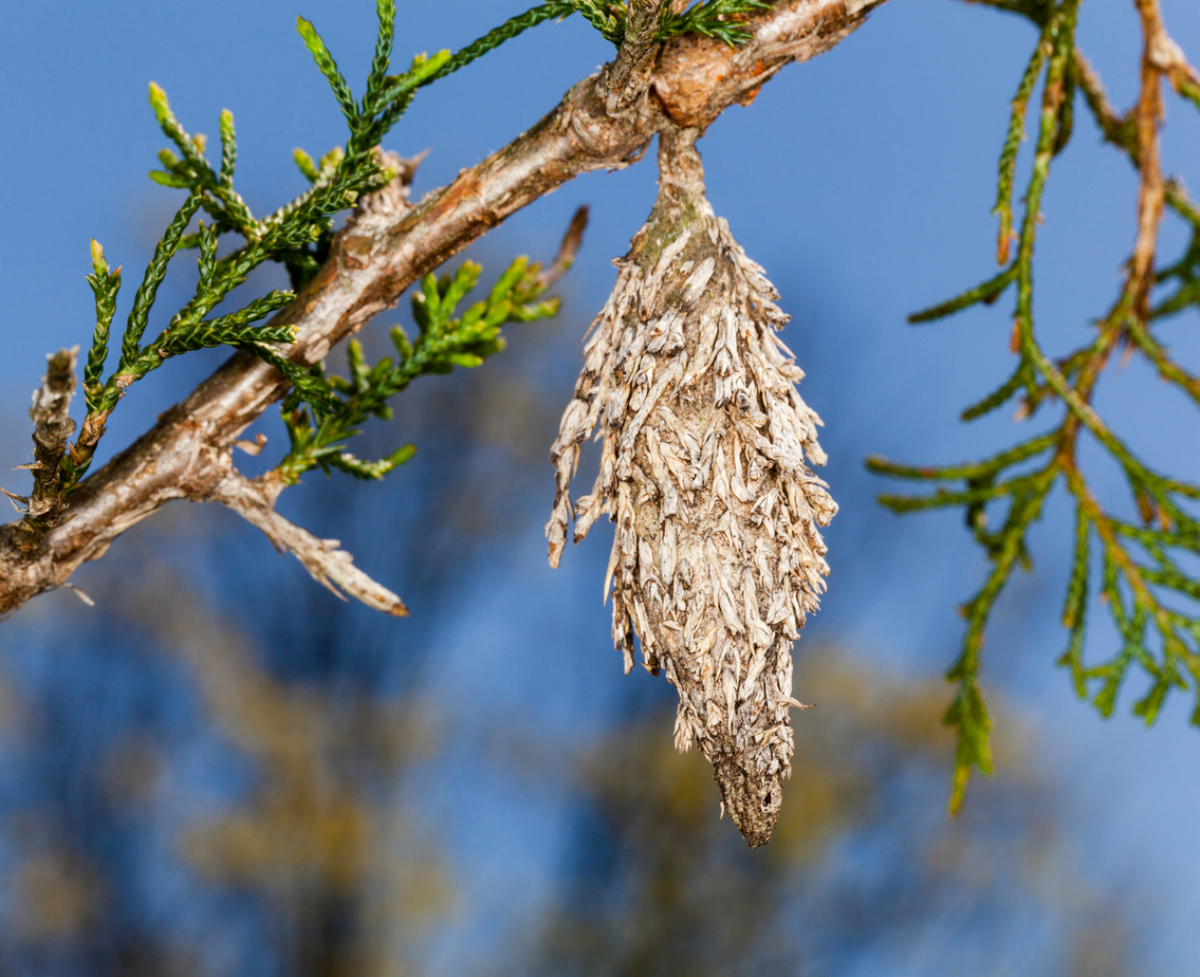
Bagworms are among the most destructive and deceptive pests threatening landscape plants across the eastern and central United States. These caterpillars live inside camouflaged protective bags on trees and shrubs, quietly stripping foliage before most homeowners realize there is a problem.
Key Takeaways
Bagworms are destructive caterpillars that build spindle-shaped bags from silk threads and plant material, blending seamlessly into tree branches. Early detection during early spring and early summer is critical to protecting your landscape trees. A professional tree health inspection can catch bagworm infestations before they cause severe damage, and ongoing residential tree services keep your property’s trees resilient year-round.
- Bagworms are the larval stage of a family of moths that attack over 120 species of trees and shrubs, especially arborvitae, cedar, juniper, and pine.
- The best windows for action are late winter through early spring for hand removal and early summer for biological control shortly after bagworm eggs typically hatch.
- Evergreen trees face the highest risk because lost needles do not regrow quickly, and heavy infestations of bagworms can kill the tree or large sections of branches.
- Hand removal of old bags and timely intervention with Bacillus thuringiensis (Bt) form the backbone of effective control.
- When bagworm populations overwhelm non-chemical methods, ISA-certified arborists can apply targeted treatments timed to the bagworm life cycle.
What Are Bagworms and Why Do They Threaten Trees?
Bagworms are the larval stage of a family of moths in the family Psychidae. These caterpillars construct distinctive spindle-shaped bags from silk and bits of leaves, bark, and twigs gathered from their host plants. Because the bags incorporate actual plant material, they blend into the tree’s foliage so well that they often resemble cones or plant debris on trees, making early detection difficult.
The bag serves as both armor and a mobile feeding shelter. Caterpillars feed from late spring through late summer, protruding from the open end of the bag to consume foliage, then retreat safely inside when disturbed. This design shields them from birds and other natural enemies while allowing larvae to move along tree branches at will.
Bagworms show a strong preference for evergreens and deciduous trees alike-they can feed on over 50 different tree families and defoliate over 50 tree species. However, evergreen bagworms on conifers cause the worst outcomes. Bagworms are especially damaging to evergreens like arborvitae, cedar, and pine because lost needles cannot be replaced until the next growing season. Bagworms can strip 80% to 100% of a conifer’s needles, and defoliation caused by bagworms reduces a tree’s ability to gather sunlight. Severe bagworm infestations can lead to permanent thinning, dieback, or death- especially of arborvitae, junipers, and cedars. Deciduous trees can push out new leaves after bagworm infestations, though repeated defoliation weakens them.
Typical bagworm damage appears as browning or thinning of tree branches, patchy canopies, and-if unchecked-entire affected plants turning brown by late summer or early fall. Bagworms cause weakening of trees, making them more vulnerable to other stresses such as drought, spider mites, scale insects, and other pests. Infestations can lead to severe damage if not managed promptly. Taylor Expert Arborists diagnose bagworm problems during routine inspections and recommend tailored management plans before significant damage occurs.
Bagworm Life Cycle and the Best Times to Act
The bagworm life cycle spans nearly a full year from egg to egg, and timing your response to each stage is the single most important factor in effective control.
- Early spring: Bagworms have a typical life cycle that includes overwintering eggs tucked inside the female bag from the previous season. From late winter through early spring, these bagworm eggs remain dormant inside overwintering bags attached to twigs. This is the ideal window to remove bagworm bags before the cycle begins again.
- Late spring and early summer: Bagworm eggs hatch in May in Kentucky and across much of the eastern U.S.; insects hatch between late May and early June. Newly hatched caterpillars are 1/8 inch long and begin feeding immediately on the tree’s foliage. Young bagworms disperse by ballooning on silken threads carried by wind currents to reach new host plants. They begin constructing small bags almost immediately. At this stage, caterpillars crawl along branches and are most vulnerable to biological control with Bt.
- Mid to late summer: As caterpillars grow through seven instars, their bags enlarge, and feeding intensifies. Larvae pupate inside their bags after 6-8 weeks of feeding. Once bags thicken in late summer, insecticides become far less effective because larvae can retreat safely inside their protective bags.
- Early fall and winter: Winged males emerge as winged moths to mate with wingless females that remain inside their bags. Adult females lay 500 to 1,000 eggs in their bags, then die. The eggs inside the female bag overwinter, and the cycle begins anew. Evergreens may take years to recover from bagworm damage sustained during a single season.
A calendar-based monitoring plan-early spring inspection for bags attached to branches and early summer scouting for tiny moving bags-gives homeowners the highest chance of preventing serious damage.
How to Identify Bagworms on Your Trees and Shrubs
Identification starts with recognizing the characteristic bagworm bags and subtle early signs of feeding on susceptible trees and shrubs.
Bagworms are identified by their distinctive spindle-shaped bags that hang from branch tips. In early summer, bags on young bagworms measure roughly a quarter inch. By late summer, bagworm bags can reach up to 4 centimeters in length, and newly hatched caterpillars grow to 2 inches at maturity. Each bag is covered with needles, leaves, or bark fragments from the host plant, so they often resemble cones or clumps of dead foliage.
To distinguish live bags from old bags, gently pinch each one. Active larvae will wriggle inside. Fresh green material visible at the open end confirms current feeding. Empty bags feel brittle, lighter, and less firmly attached. Common affected plants include landscape favorites like arborvitae, eastern red cedar, Leyland cypress, juniper, spruce, and pine. Certain deciduous trees such as maple, oak, and sycamore also serve as host plants, along with various ornamental shrubs. Bagworms can completely defoliate areas of host plants when populations are high.
Beyond the bags themselves, look for patchy defoliation, thin sections in evergreen screens, and clusters of bags hanging from branch tips. Bagworms primarily damage evergreen trees like junipers and cedars, so these deserve close attention. If you are unsure whether you are looking at seed pods or bagworm bags, schedule a professional tree health inspection to confirm identification before damage escalates.
Non-Chemical Control: Hand Removal and Cultural Practices
Mechanical control-hand removal of bagworm bags-is the most environmentally friendly option and delivers strong results when smaller infestations are caught early and within reach on small trees and shrubs.
Remove bagworm bags in winter or early spring before eggs hatch. Use pruners or gloved hands to detach each bag from its branch, then immediately drop it into a bucket of soapy water or seal it in a trash bag. Bagworms can be destroyed by crushing their bags or submerging them in soapy water. Dispose of collected bags off-site so eggs cannot hatch on your property. Manual removal of bags is effective for controlling bagworm infestations, and manual removal can prevent hatching and new infestations entirely when done thoroughly.
Hand removal is also helpful in late summer or early fall, but by that stage some damage has already occurred. Removal before egg hatch in early spring yields the greatest benefit. Treatment timing is crucial in managing bagworm infestations at every stage.
Practical limitations exist: very tall or densely planted evergreens may hide many bags out of sight. Partial removal still reduces pressure on infested plants but often needs to be paired with professional treatment on larger properties.
Cultural practices that reduce tree stress help trees recover from moderate bagworm damage more quickly. Appropriate watering during drought, mulching to protect roots, avoiding trunk damage, and periodic structural pruning all support overall vigor. Include seasonal bagworm scouting and bag removal as part of your regular residential tree services schedule to prevent a minor bagworm problem from becoming a severe outbreak.
Biological Control and the Role of Beneficial Insects
Biological control combines targeted products like Bt with conservation of natural predators-especially parasitic wasps and birds-that attack bagworms at various life stages.
Bacillus thuringiensis is effective against bagworm larvae when caterpillars ingest treated foliage. Applications work best in late spring and early summer shortly after eggs hatch, when larvae are small and feeding actively. For best results, apply Bt in mild, dry weather and repeat every seven to ten days while tiny larvae are present. Direct the spray to thoroughly coat the outer foliage of affected plants so feeding caterpillars consume a lethal dose.
Natural enemies such as ichneumonid parasitic wasps and Trichogramma wasps parasitize bagworm eggs and larvae, helping to keep bagworm populations from rebounding after treatment. Introducing natural predators into the landscape through habitat conservation is a long-term strategy that pays dividends. Homeowner practices that support beneficial insects include planting diverse flowering species, reducing broad-spectrum insecticides, and leaving some undisturbed ground cover where predators can thrive.
Taylor Expert Arborists can design integrated biological control programs that prioritize low-impact options while still protecting valuable evergreen trees and ornamental shrubs from serious defoliation.
Chemical Treatment Options and When to Use Them
Chemical intervention is generally reserved for moderate to severe bagworm infestations, large or tall trees where hand removal is impractical, or properties with a repeated history of bagworm problems.
Foliar sprays are most effective when directed at small, actively feeding larvae in early summer before bags become thick and resistant. Once bags harden in late summer, even strong sprays may fail to reach the caterpillars inside. Inspect trees regularly to catch bagworm infestations early and time applications to the narrow window after eggs hatch.
Safer, targeted insecticides include formulations containing spinosad or Bt, which focus on caterpillars and are less disruptive to many beneficial insects when applied at dusk or early evening. Chemical controls include spinosad and pyrethroids as primary treatment options. Stronger broad-spectrum products, including certain pyrethroid insecticides or older chemistries, can provide knockdown of heavy infestations. These should only be used by trained professionals who can minimize drift, respect pollinator safety, and comply with label directions.
Always follow label directions, keep children and pets away from treated areas until sprays dry, and consider weather conditions and nearby water sources when planning applications. Louisiana State University extension research and similar sources confirm that sprays applied to young larvae can achieve over 80% mortality, but efficacy drops sharply once the adult moth stage approaches and bags are sealed.
Taylor Expert Arborists can time treatments precisely to egg hatch, select appropriate products, and combine chemical tools with biological and cultural controls for comprehensive management.
Year-Round Prevention and Professional Help for Bagworms
A seasonal prevention plan stops bagworms on trees before they cause irreversible harm. During late winter and early spring, inspect landscape plants for old bags and remove them. In early summer, scout for tiny moving bags and early bagworm damage on new growth. By late summer, assess overall tree health and determine whether residual control or planning for next year is needed.
Pay special attention to windbreaks, privacy screens, and specimen evergreens. These are often the first and worst-hit areas when bagworm populations build along property lines and fence rows. Bagworms can defoliate up to 50 tree species in a mixed landscape, so no planting is truly immune.
A recurring relationship with a trusted arborist makes prevention easier. Scheduled tree health inspections catch problems early, and any suspected bagworm infestations can be evaluated before they spread to additional trees and shrubs. Integrated residential tree services from Taylor Expert Arborists-including pruning, fertilization, and pest monitoring-keep trees resilient against future stressors, not just bagworms.
Even serious bagworm infestations can often be managed if homeowners act quickly. If you notice suspicious bags or sudden browning on your evergreens, contact Taylor Expert Arborists promptly. Timely intervention and early detection are the difference between a minor setback and losing a mature tree.


