

When you step outside and notice brown or black spots on your maple leaves, it’s natural to feel concerned. Are your trees sick? Is it a fungus? Will the tree recover? If this sounds familiar, take a deep breath. As the leading tree care specialists in New Jersey, Taylor Expert Arborists understands this concern completely. In fact, calls about spots on maple leaves are one of the most common reasons homeowners reach out for our residential tree services. The good news is that these spots are often a sign of a common, treatable issue rather than a tree-ending catastrophe. The key is to correctly identify the cause, which is the first step we take during a professional tree health inspection.
In this comprehensive guide, we’ll draw on our 12 years of experience to walk you through the primary causes of brown and black spots on maple leaves. We’ll explore the most common fungal diseases, explain how environmental stress plays a major role, and provide actionable advice you can use to protect your trees.
Common Causes of Brown and Black Spots on Maple Leaves
If your maple tree’s leaves are turning brown or developing black speckles, don’t panic—these symptoms often point to a common leaf disease rather than a long-term threat to your tree’s health. In New Jersey, where humid summers and moisture-heavy weather patterns are the norm, fungal growth thrives, making maple trees especially vulnerable to diseases that create leaf discoloration.
However, it’s not always a fungus. Sometimes, these spots are the tree’s way of telling you it’s thirsty, hungry, or stressed out. Our job as arborists is to read those signs. Let’s break down the most common causes, starting with the most visible.
Fungal vs. Environmental: The Two Main Culprits
Every leaf spot tells a story. Broadly, these stories fall into two categories: fungal (pathogenic) or environmental (abiotic).
- Fungal Diseases: These are caused by microscopic fungal organisms (spores) that land on the leaf, “infect” it, and begin to feed on the leaf tissue. This feeding is what creates the visible spot or lesion. These maple tree fungus issues are often cosmetic but can sometimes escalate.
- Environmental Stress: This is a non-infectious, or “abiotic,” issue. The spots are a symptom of an underlying problem like drought, nutrient deficiency, or root damage. In this case, the tree is under stress, and the leaves are showing the strain.
Often, these two are linked. A stressed maple tree will have a weaker immune system, making it far more susceptible to a fungal attack. A healthy, vigorous tree can often fight off the same fungal spores that would devastate a stressed one.
Tar Spot Disease — The Most Common Culprit
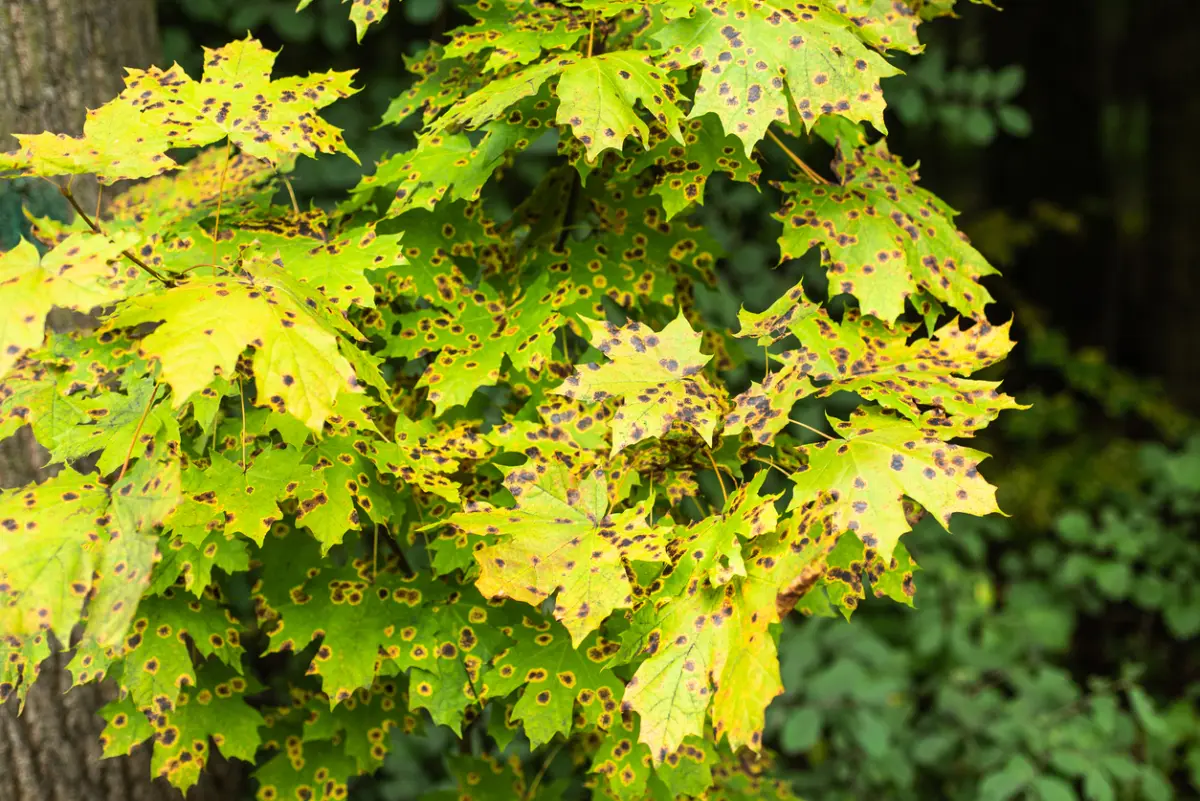
Tar spot is one of the most recognizable and widespread maple leaf diseases. Caused by the fungus Rhytisma acerinum, it begins as tiny, pale yellow spots shortly after leaves emerge in spring. As the season progresses, these spots expand into raised, black, tar-like patches that give the disease its name.
Symptoms of Tar Spot
- Small yellow dots that enlarge throughout the season
- Raised, black, glossy patches that resemble asphalt drops
- Premature leaf drop in some cases
While these black spots may look alarming, tar spot rarely threatens the long-term health or structure of your maple tree. Instead, it’s mainly a cosmetic issue.
Is Tar Spot Harmful to My Maple Tree?
This is the question we hear most often, and the answer is a relief: Almost never.
While the spots are unsightly and can be alarming, tar spot is considered a cosmetic disease. It shows up very late in the growing season. By the time the black spots are fully formed, the leaves have already spent the entire spring and most of the summer performing photosynthesis, creating and storing the energy the tree needs for the winter and for its initial growth next spring.
In very severe cases, a heavy infection might cause some leaves to drop prematurely in the fall. But even then, the tree has already banked the vast majority of its energy. It will almost certainly leaf out beautifully the following spring.
How Tar Spot Develops
Fungal spores overwinter in infected leaves on the ground. When spring moisture and warming temperatures arrive, spores release and infect emerging leaves.
How to Prevent and Manage Tar Spot
Because the disease is cosmetic, the tar spot on maple leaves treatment is more about management than “curing.”
- Sanitation is Everything: The #1, most effective, and cheapest way to how to prevent maple leaf fungus like tar spot is to rake and destroy the fallen leaves in the fall. This is the actionable advice we give every client. By removing the leaves, you are removing the fungus. You are breaking its life cycle. If there are no infected leaves on the ground in spring, there are no spores to infect the new leaves.
- Leaf Disposal: Don’t just rake them into a pile at the back of your property. The spores can still travel. If possible, have them bagged and removed with your municipal yard waste. Hot composting or shredding them with a lawnmower can also help destroy the fungal structures.
- Fungicides? For tar spot, fungicides are rarely necessary or recommended for homeowners. They are purely preventative, not curative (they can’t remove existing spots). They would need to be applied in early spring, just as the leaves are budding, and timed perfectly to block the spores. For a mature tree, this is an expensive and difficult process for a purely cosmetic issue. Good fall cleanup is far more effective.
Maple Anthracnose — Early Season Leaf Browning
Anthracnose is another common fungal disease affecting maple trees, especially during cool, wet springs. Unlike tar spot, which produces distinctive black patches, anthracnose causes browning that follows the leaf veins or appears on leaf margins.
Symptoms of Maple Anthracnose
- Brown or tan blotches along leaf edges
- Browning or distortion along major veins
- Curling, wilting, or premature leaf drop
- More severe symptoms in young or stressed maple trees
Maple Anthracnose vs. Tar Spot: Key Differences
It’s easy to confuse the two, but they look and act very differently.
- Timing: Anthracnose appears in spring. Tar Spot appears in late summer.
- Appearance: Anthracnose causes irregular, tan-to-dark-brown blotches, often spreading along the leaf veins or scorching the leaf edges. The spots may look sunken or dead. Tar Spot creates distinct, raised, circular, black spots.
- Impact: Anthracnose can be more damaging. Because it attacks new growth, it can cause maple leaf blight symptoms, twisting or killing young leaves, leading to premature leaf drop in late spring or early summer. It can also infect and kill small twigs. Tar spot is almost purely cosmetic.
What Causes Anthracnose?
The fungi responsible for anthracnose thrive in moisture. When spring rain is frequent and temperatures remain cool, fungal spores spread easily across new leaf growth.
Treatment and Management
Because this disease can impact the tree’s ability to photosynthesize and can cause twig dieback, management is more important.
- Sanitation (Again!): Just like tar spot, this fungus overwinters in fallen leaves. Raking and destroying leaves in the fall is a critical first step.
- Promote Airflow: This is a huge factor. Fungi need moisture to thrive. A dense, overcrowded canopy traps humidity and keeps leaves wet for longer, creating a perfect fungal paradise.
- Dormant Pruning: The best time to prune diseased maple trees is in the late winter (dormant season). A certified arborist can strategically thin the canopy to improve airflow and sunlight penetration. This helps leaves dry off faster in the spring, making it much harder for the anthracnose spores to infect them. We also remove any dead or cankered twigs that could be harboring the fungus.
- Water Smart: Water your tree at its base (with a soaker hose or deep-root watering), not with an overhead sprinkler that soaks the leaves. Water in the morning, so any accidental spray can dry quickly.
- Fungicides: For trees with a chronic and severe history of anthracnose, a preventative fungicide spray applied by a professional in the spring can be very effective. This is a treatment we at Taylor Expert Arborists can schedule as part of a tree disease prevention New Jersey plan, applying the correct product at the precise time (at bud break) to protect the new leaves.
Environmental Stress and Nutrient Deficiency
Not all maple leaf problems are caused by fungus. Environmental stressors or nutrient deficiencies often cause brown spots, leaf scorch, or other discoloration.
1. Leaf Scorch: Too Much Sun, Not Enough Water
This is one of the most common non-fungal maple tree leaf problems.
- What it is: Leaf Scorch is not a “sunburn.” It’s a sign of water-related stress. It happens when a leaf loses water through transpiration (its “sweat”) faster than the roots can pull new water up from the soil. The leaf tissues literally dry out and die, starting at the furthest point from the veins.
- Symptoms: You’ll see browning and crisping that starts at the very edges of the leaves and moves inward, between the main veins. It often looks like a “V” shape. It’s usually most severe on the side of the tree that gets the most sun and wind (often the south or west side).
- Causes:
- Drought Stress: The most obvious cause. Hot, dry, windy weather in summer, with no supplemental water.
- Root Damage: Construction, digging, or even soil compaction can damage a tree’s root system, making it unable to absorb enough water, even if the soil is moist.
- Overwatering: This one surprises people. Constantly waterlogged soil can lead to root rot. Rotting, dead roots can’t absorb water, which leads to… leaf scorch.
- Girdling Roots: A root that wraps around the trunk or other major roots can slowly choke off the flow of water and nutrients, leading to signs of a stressed maple tree, including scorch.
2. Nutrient Deficiency: When Leaves Turn Yellow and Brown
A tree is a living thing; it needs to eat. When the soil is missing key nutrients, the leaves are the first to show it.
- What it is: Your soil’s pH or composition may be locking up key minerals, or they might just not be present.
- Symptoms:
- Iron or Manganese Deficiency: Very common in the alkaline (high pH) soils we often see in New Jersey. This causes chlorosis—the leaf turns pale yellow, but the veins remain dark green. In severe cases, the yellow tissues will die and turn into brown, dead spots.
- Potassium Deficiency: Often shows up as scorching or browning on the leaf margins, similar to scorch, but typically starts on older leaves first.
- The Problem with Guessing: The worst thing you can do is just dump a generic “tree fertilizer” on it. If your tree has an iron deficiency because the soil pH is too high, adding a high-phosphorus fertilizer can worsen the problem by making the iron even less available. This is where a professional tree health assessment is not just helpful, but essential. We take soil samples to find out exactly what’s going on and prescribe a targeted treatment.
How to Treat and Prevent Leaf Spot Problems (A Proactive Approach)
As arborists, we believe in holistic, proactive care. Treating leaf spot on trees isn’t just about spraying a fungicide; it’s about building a healthy, resilient tree that can defend itself.
Here is your 4-pillar game plan for maple tree health.
Pillar 1: Sanitation (Your Best Defense)
We can’t say this enough: Rake and dispose of all infected leaves in the fall. This single action is the most powerful tool you have against tar spot, anthracnose, and many other fungal diseases in maple trees. It breaks the cycle of infection.
Pillar 2: Smart Pruning for a Healthy Canopy
Schedule annual pruning with a certified arborist. We’re not just cutting branches; we’re sculpting the tree for health.
- Improves Airflow: Thinning the canopy allows air to move freely, drying leaves faster after rain.
- Increases Sunlight: More sunlight penetration discourages shade-and-moisture-loving fungi.
- Removes Disease: We identify and remove dead or cankered twigs that act as reservoirs for fungal spores.
Pillar 3: Proper Watering and Mulching
Your tree’s roots are its life-support system.
- Mulch: Maintain a 2-3 inch layer of organic mulch (like hardwood chips) over the root zone. This helps retain soil moisture, keep roots cool, and suppress weeds. Crucially, do not let the mulch touch the trunk! This “volcano mulching” can trap moisture against the bark and lead to rot.
- Water: Water deeply and infrequently. During dry spells, a long, slow soak at the base of the tree once a week is far better than a light sprinkling every day.
Pillar 4: Proactive Monitoring and Nutrition
The best time to solve a problem is before it starts.
- Inspect Your Trees: Walk your property regularly, especially during the maple leaf problems in summer. Notice changes. Catching a problem early is half the battle.
- Feed Your Tree: Don’t guess, get a soil test. A professional arborist can perform deep-root fertilization, injecting a custom-blended, slow-release fertilizer directly into the root zone to address specific deficiencies and boost overall vigor.
When to Call a Professional Arborist
Most of the time, leaf spots are a minor issue. But how do you know when it’s a sign of something more serious?
You should call a certified arborist for a tree health assessment if you notice:
- Persistent Issues: The spots come back year after year, even with good fall cleanup.
- Early Leaf Loss: The tree loses a significant portion of its leaves in spring or early summer.
- Compounding Symptoms: The leaf spots are accompanied by other red flags: peeling bark, oozing liquid, mushrooms growing at the base, or significant branch dieback.
- A Young or Stressed Tree: A newly planted or young maple is far more vulnerable than an established, mature one. Spots on a young tree should be taken more seriously.
- You’re Just Not Sure: Peace of mind is priceless. A professional diagnosis can distinguish between a cosmetic tar spot and a more serious underlying issue.
What a Certified Arborist Can Do
When you call our team at Taylor Expert Arborists, we don’t just look at the leaves. We look at the entire system.
- Accurate Diagnosis: We will identify fungus species or abiotic stressors. Is it tar spot, anthracnose, or bacterial leaf spot? Is it scorch from drought, or is it a sign of Verticillium Wilt, a much more serious vascular disease?
- Soil & Tissue Analysis: We can take soil and leaf samples for lab testing to get concrete data on nutrient deficiencies or pathogens.
- Targeted Treatment Plans: We create a holistic plan. This may include:
- Expert Pruning: To improve airflow and remove diseased wood.
- Soil Treatment: A custom plan of deep-root fertilization, soil amendments to correct pH, or treatments to manage root rot.
- Professional Fungicide Plans: If necessary, we can schedule and apply preventative treatments at the precise time they will be effective.
- Comprehensive Health Check: We’ll check for other stressors like borers or root rot. Often, the leaf spots are just a symptom. We find the root cause.
Your maple tree is a massive asset to your property. Don’t let leaf spots leave you guessing.
At Taylor Expert Arborists, we diagnose and treat maple leaf diseases all across New Jersey. Our certified team is dedicated to ensuring your trees stay healthy, vibrant, and ready for every season. If you’re worried about your maple, call us today to schedule a comprehensive tree health inspection and let us partner with you in caring for your beautiful landscape.


